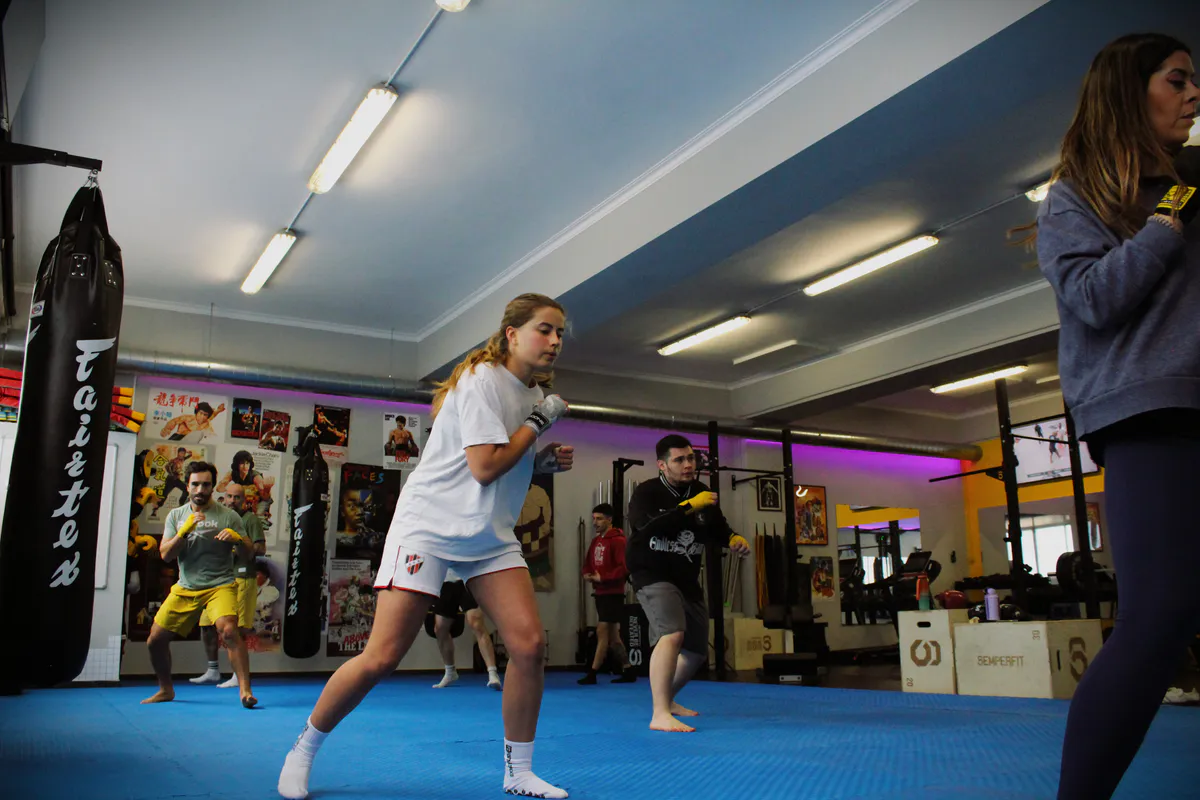
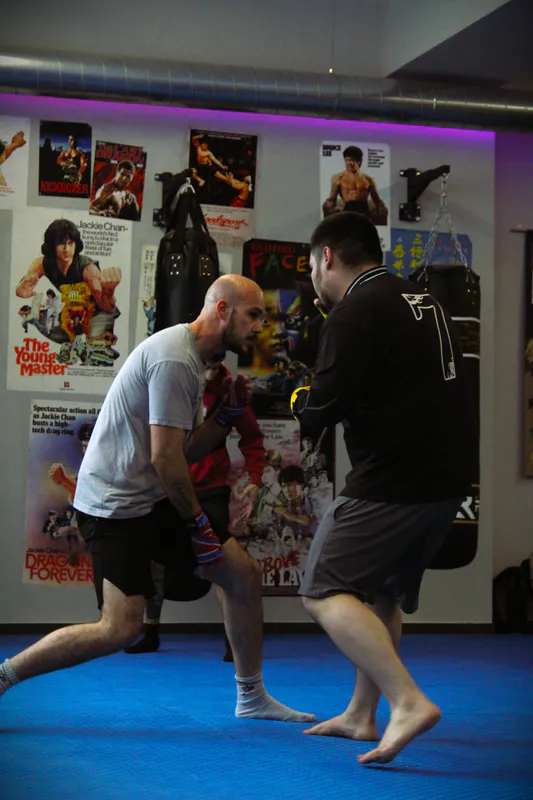
Lisbon isn’t New York. But the sense of safety has shifted in recent years — and more and more people are showing up at the gym with “self-defence” as the trigger for starting. Mostly women, mostly from their 30s onwards.
The question they usually arrive with is “what’s the most effective martial art to defend myself?” The right question is a different one: which one am I actually going to keep doing for five years? Because real self-defence isn’t learned over a weekend. It’s learned by training one serious discipline, consistently, for years. Everything else is theatre.
This article covers the three martial arts we teach at Be Water that, combined, build the most complete base for real self-defence: Boxing, Muay Thai and Brazilian Jiu-Jitsu (BJJ). No myths, no fantasy rankings, no promises of “becoming deadly in 30 days”.
What self-defence actually is (and isn’t)
Before comparing modalities, three ideas being sold around need to be cleared up:
1. Self-defence isn’t Hollywood. In a real situation, no one runs choreographed combos. What works is the opposite: a few movements, well-trained, executed under stress. The person who has thrown a simple jab 100 times will win — almost every time — against someone who learned 50 different techniques once each.
2. The best scenario is always to avoid. Serious training teaches you to read the environment, keep distance, not escalate verbally — and to create a window to leave. Training to “win the fight” is starting with the wrong mindset. Training to avoid needing the fight is the goal.
3. Weekend courses don’t work. Four-hour “women’s self-defence” workshops are, for the most part, false security wrapped in good marketing. What works is consistent training — 2 to 3 times a week, for months — in a real discipline, with a real coach, under some form of resistance.
That said, of the modalities available in Lisbon, three deliver disproportionate value for anyone wanting to learn to defend themselves: Boxing, Muay Thai and BJJ. Each with different strengths.
The 3 martial arts we recommend for self-defence
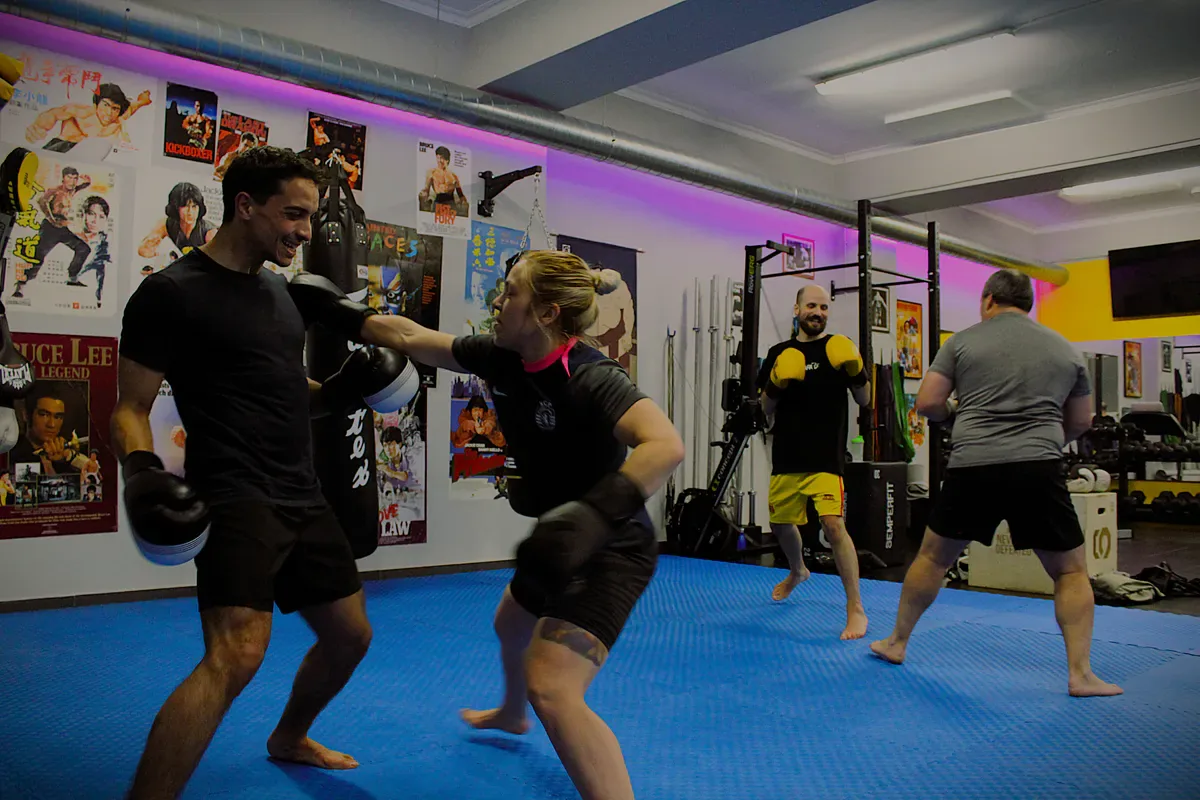
Boxing
Strengths: boxing specialises in two things that are gold in a real situation — distance reading and footwork. You learn to spot when someone is inside your “danger sphere”, to exit through angles, to deliver a short, precise punch (not a wild swing), and to defend with slip, roll and cover. The four punches (jab, straight, hook, uppercut) cover 90% of scenarios — and trained thousands of times become reflexive.
Limitations: boxing uses only the hands and works standing up. It doesn’t teach you to handle prolonged clinch, grappling or ground work. If the situation goes to the floor, it’s a different territory.
When it makes the most sense: if you want fast practical application — it has the gentlest entry curve of the three. There’s no complicated ground game or technical clinch to master. In 6 months you have a useful base.
Time to be useful: ~6 months of consistent training.
To learn more, read our Boxing for beginners in Lisbon guide. Modality details at /modalidades/boxe.
Muay Thai
Strengths: the “art of 8 weapons” — fists, elbows, knees and shins. Adds three short-range weapons (elbows, knees) and two long-range weapons (shins, low kicks) to boxing’s toolkit, plus clinch — controlling and attacking from a neck grab. It’s perhaps the most complete standing martial art that exists. If the scenario is standing and at medium distance, Muay Thai covers almost everything.
Limitations: high intensity. The first weeks are physically demanding — shins hurt, cardio hurts. It’s not a gentle entry point if you’ve never trained. And, like boxing, it doesn’t train ground work.
When it makes the most sense: for someone who wants conditioning alongside defence and a complete standing arsenal. Also excellent to complement boxing later — many of our members train both.
Time to be useful: ~6-9 months of consistent training.
More detail in Muay Thai for beginners in Lisbon and 5 benefits of Muay Thai that go beyond the ring. The modality at /modalidades/muay-thai.
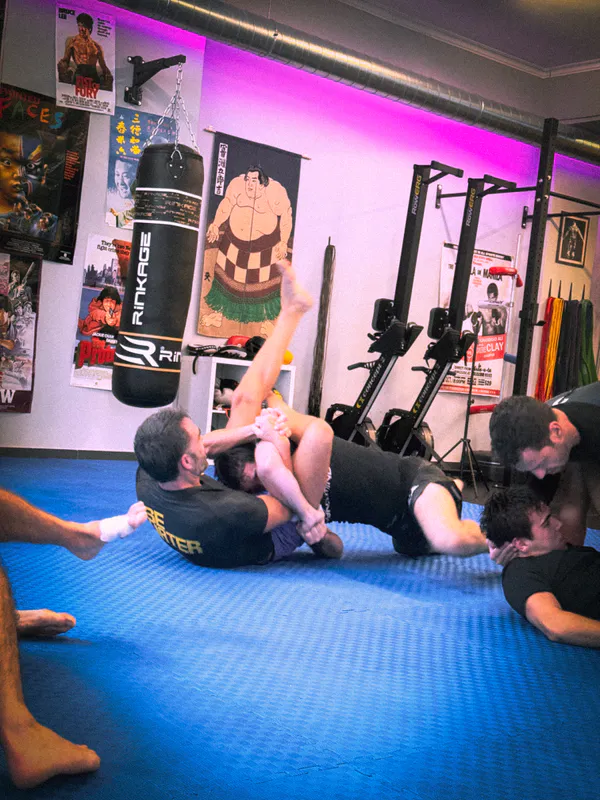
Brazilian Jiu-Jitsu (BJJ)
Strengths: BJJ is by far the most effective martial art when the scenario falls to the ground — and statistically, in real-life violent situations (especially involving grappling), there’s a high probability of ending up on the floor. More importantly: BJJ allows a smaller, lighter person to neutralise and control a heavier one without striking. That isn’t just a technical advantage — it’s a moral one. You can stop a situation without injuring someone.
Limitations: BJJ doesn’t train striking. It won’t teach you to defend against punches or kicks standing up. If the situation stays at standing distance, BJJ alone isn’t enough — hence the classic recommendation to complement it with boxing or Muay Thai.
When it makes the most sense: if you’re physically smaller or lighter than potential aggressors, BJJ is probably the single best choice you can make. Also excellent for those who prefer to “control” rather than “strike” — it’s an intelligent martial art, more technical than explosive.
Time to be useful: ~12 months for a functional base. It’s the slowest of the three — but also the deepest.
Details in Jiu-Jitsu for beginners and BJJ Gi vs No-Gi: which to choose. Meet the modality at /modalidades/jiu-jitsu, led by Master Alexandre Izidro, 6th-degree black belt.
Side-by-side comparison
In quick format:
| Criterion | Boxing | Muay Thai | BJJ |
|---|---|---|---|
| Contact in first class | Medium | High | Low-Medium |
| Time to useful base | ~6 months | ~6-9 months | ~12 months |
| Physical intensity | High | Very high | Medium (technique > physicality) |
| Effective vs. someone bigger | Medium | Medium | High |
| Scenario | Standing, at distance | Standing + clinch | Ground + control |
| Learning curve | Gentle | Steep early on | Long but deep |
| Long-term injury risk | Medium (hands, ribs) | Medium-high (shins) | Low-medium (joints) |
None is “the best”. Each solves different scenarios. Most serious fighters train at least two in parallel — and Be Water’s plans give you access to all of them in the same price, precisely for this reason.
Which to choose? By profile
To avoid choice paralysis, here’s the recommendation by concrete situation:
- Women 25-45 who want “real” self-defence: start with BJJ — it’s where the “neutralise a bigger aggressor” advantage is clearest — and add Boxing after a few months so you also cover standing distance.
- Men 30-45 who want conditioning + defence at once: Muay Thai. Almost no one leaves a class without sweating, and the arsenal covers practically everything that matters standing up.
- 40+ who’ve never trained anything: Boxing or BJJ. Boxing if you want a gentler curve; BJJ if you prefer technique over impact. Avoid starting with Muay Thai without prior conditioning — the intensity is unnecessarily high for a 40+ beginner.
- People who can only train 1x per week: Boxing. It delivers the fastest return with the least volume. Everything else requires a minimum 2x/week.
- People willing to invest 3-5 years seriously: BJJ. It’s the deepest of the three — those who reach blue belt (1.5-2 years) already have tools for real situations they didn’t know existed.
And if you’re still undecided: all three classes are in the same plan. You try everything in the first month and choose from there.
The unpopular truth
The best martial art for self-defence is the one you’ll manage to do 3 times a week for years.
Seriously. The entire technical discussion above is secondary to this. A boxer with 2 years of consistent training will resolve a situation better than a “theoretically superior” BJJ amateur who trains once a month. Consistency is the one variable that always wins.
If one of them excites you more — pick that one. If one of them fits your schedule better — pick that one. The “best martial art in the abstract” doesn’t exist. The one you’ll keep does.
How we train self-defence at Be Water
To be clear: Be Water does not offer a standalone “self-defence” course. It offers consistent training in three real martial arts — and that is exactly what builds real self-defence.
In practice that means:
- Small classes with a coach next to you. You’re not one more person in a 30-strong factory. Each coach knows you by name and corrects your technique in real time. Read more on how to choose a martial arts gym in Lisbon.
- The right coaches. Boxing with Arménio Reis (6x national champion). Muay Thai with Diogo Calado (world and European champion). BJJ with Master Alexandre Izidro (6th-degree black belt). Not personal trainers with a weekend workshop.
- Controlled sparring, never mandatory. Sparring enters when the student is ready — technically and mentally. Before that, it’s technique, bags, pads and drills with progressive resistance.
- Access to all 3 modalities in the same plan. You can start with one and add others when your body can handle it. No extra cost.
Not sure where to start? Read What does your first class at Be Water look like? — it explains in detail what to expect, what to bring and how to behave.
A note for women
This deserves a dedicated section because the problem is different. In situations of violence against women, the aggressor is typically heavier, stronger and taller. The tactic can’t be “trade strikes” — it has to be neutralise, create distance or control until you can leave.
That’s why we recommend BJJ as a base for anyone whose main motivation is self-defence as a woman: it’s the only one of the three where the aggressor’s mass advantage is partially cancelled by technique. And it’s also why, at Be Water, several women train BJJ and Boxing in parallel — the combination covers the overwhelming majority of scenarios.
For more on combat training for women, see Women’s boxing in Lisbon: why start now. And for a broader reflection on what changes in people who train, Martial arts and mental health: how training changes your life.
Three-line summary
- The three martial arts cover different scenarios — Boxing for medium-range standing, Muay Thai for the complete standing + clinch arsenal, BJJ for the ground and against bigger aggressors.
- The “best” doesn’t exist in the abstract. The one you’ll manage to train 2-3 times a week for years does.
- The ideal combination for serious self-defence is BJJ (ground / neutralisation) + Boxing or Muay Thai (standing). At Be Water, all modalities are included in the same plan.
Start now
Book a free trial class on WhatsApp (933 869 791). You can start with any of the three modalities — and try the others in the following weeks at no extra cost. Arrive 15 minutes early, bring comfortable clothes, and leave the rest to us. Plans from €64.90/month, no lock-in.
Be Water Lisboa — Av. do Brasil 7, Campo Grande. Monday to Friday 6:30am–9pm, Saturday 10am–1pm, Sunday 11am–12pm (Open Gym + Open Mat).
— Be Water Team