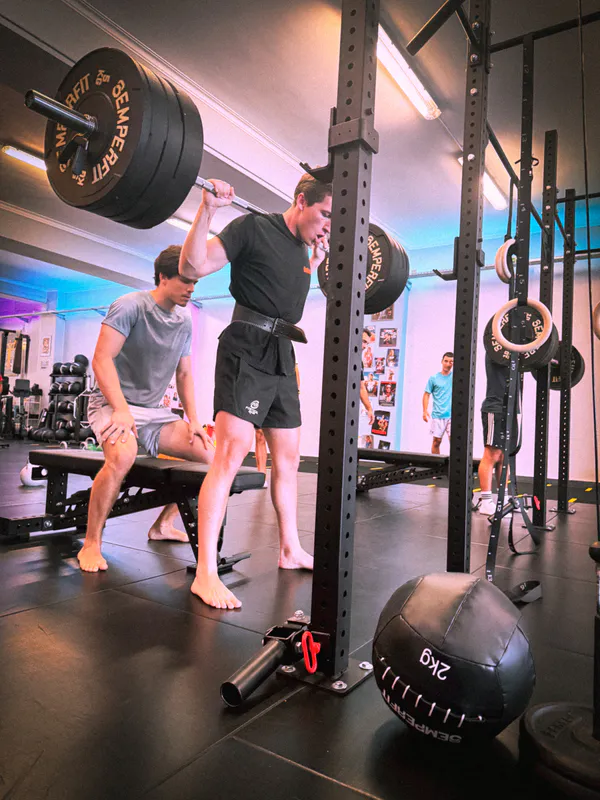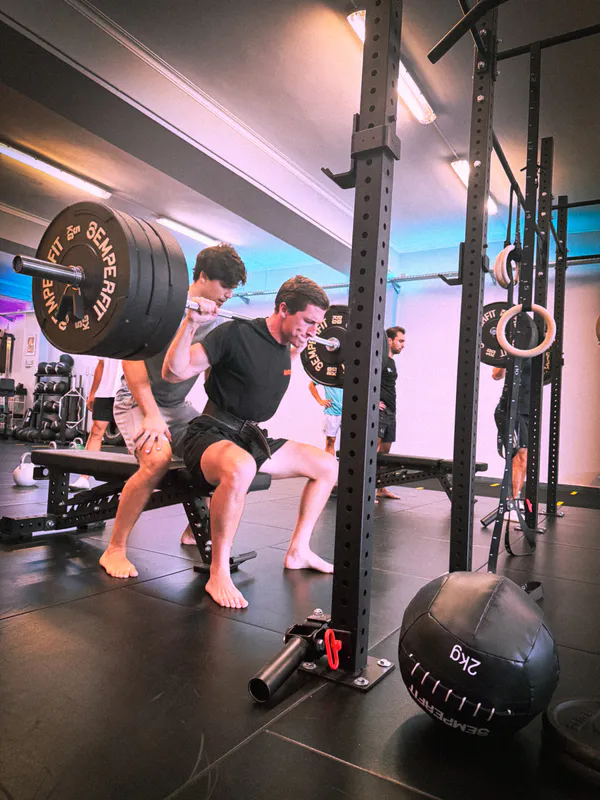
There’s a pattern we see every week: the practitioner who never misses a strength session or a fight class, but who “has no time” for mobility work. Until the day the shoulder stops letting them sleep, the lower back locks up mid-lift or the knee complains inside a closed guard. Mobility is the training everyone cuts first — and the one they miss most when it’s gone.
Mobility is not (just) stretching
Let’s sort out the concepts. Flexibility is a muscle’s passive range — how far it stretches when something pulls it. Mobility is the range you can use actively and under control: the hip that opens and holds load in that position, the shoulder that rotates and stabilises at the end of the movement.
That’s why classic static stretching — 30 seconds standing still pulling on a muscle — solves little on its own. What the body needs to train without breaking is control within range: dynamic stretching, active joint work and strength in end-range positions. That is exactly the work of a BE FLEX session.
Why you lose mobility (even while training)
Modern life is a range-shortening machine: 8 hours sitting shorten the hip flexors, the phone and the desk close the shoulders and thoracic spine, and stress stores tension in the neck and traps.
And here’s the uncomfortable part: training hard doesn’t fix this — it can even make it worse. Strength without range builds strong muscles across short movements. The result is a body that’s powerful within a small window, and fragile outside it. That’s where injuries happen: on the kick that’s higher than usual, on the overstretched hip escape, on a lift caught in a bad position.
The most common injuries in people who train
In people combining fighting and strength training, the complaints repeat themselves:
- Shoulders — the most mobile joint in the body is also the most unstable. It suffers in boxing, in armlocks and in pressing.
- Lower back — pays the bill for stiff hips: when the hip doesn’t rotate, the lumbar spine compensates. Lifts, guards and kicks charge interest.
- Hips — fundamental to everything: squats, BJJ guard, Muay Thai kicks. Stiffness here limits technique and overloads knees and spine.
- Knees — the problem rarely starts there; they tend to be victims of what the hip and ankle fail to do.
- Neck and hands — the classic grappling complaints, which improve enormously with range work and specific strength.
The good news: the vast majority of these complaints don’t appear overnight. They’re built over months of neglected range — and they’re prevented the same way, with regular work.
What BE FLEX is
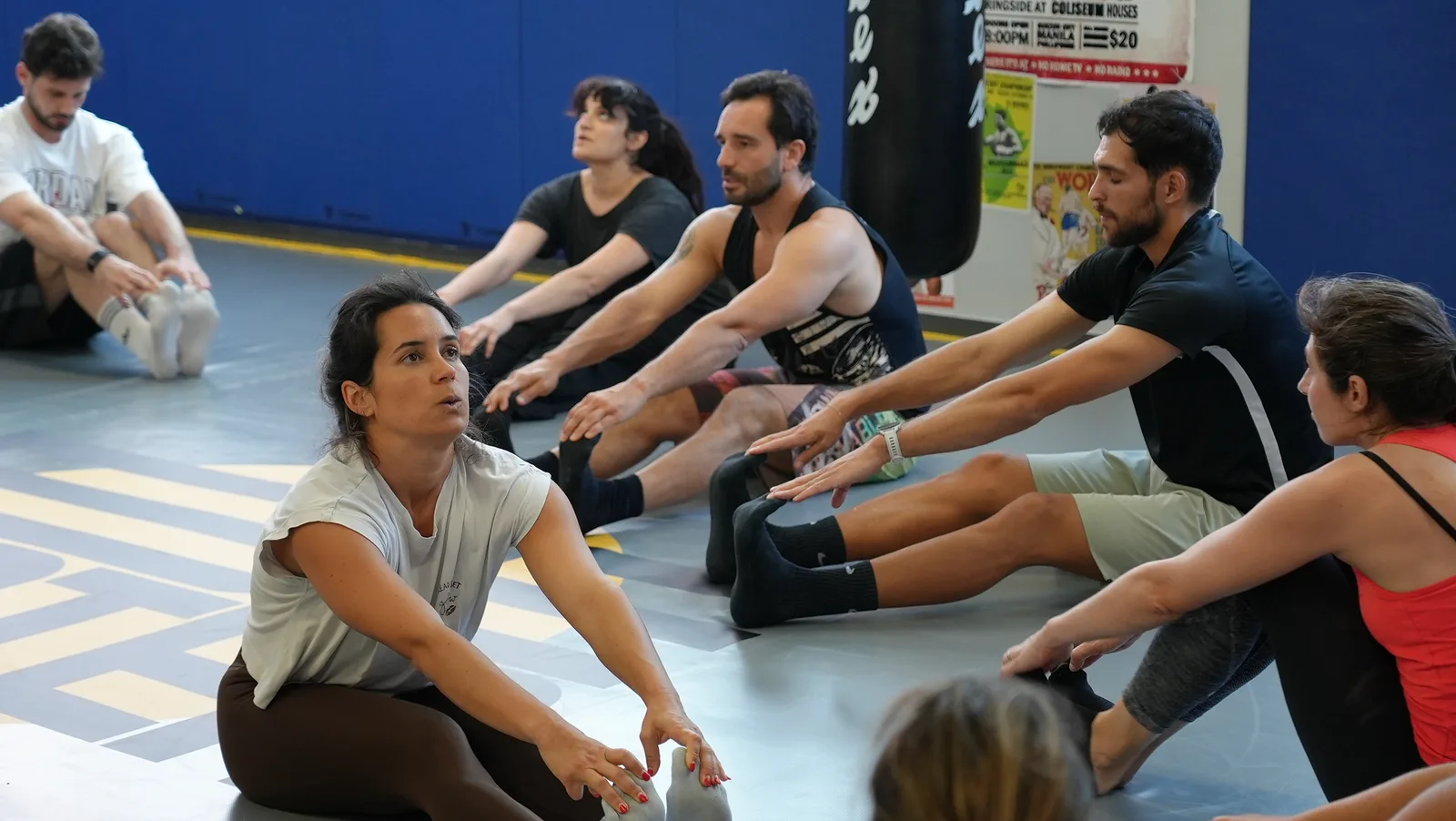
BE FLEX is Be Water’s session dedicated to mobility, dynamic stretching and flexibility. A structured hour to open what the week closed: hips, shoulders, thoracic spine, ankles and neck.
| Days | Time |
|---|---|
| Tuesday and Thursday | 18:15 |
See the full schedule for all disciplines.
A typical session combines controlled joint work, dynamic stretching through movement, end-range positions held with active tension, and breathing work to bring the nervous system down at the end. You don’t need to be flexible to start — just as you don’t need to be fit to start training. You start where you are.
How it fits the rest of your training
BE FLEX isn’t a discipline “on the side” — it’s the multiplier of the others:
- Jiu-Jitsu: guard, escapes and inversions live off hip and spine mobility. More range means more technical options and fewer positions where you get stuck.
- Muay Thai and boxing: kick height and fluidity are born in the hip; punching rotation power is born in the thoracic spine. Range is power.
- Functional training: squat depth, a stable overhead position, ankle mobility. Almost every technical limit we see in BE WATER classes has a mobility restriction behind it.
Since the plans include all disciplines, the pattern we recommend is simple: use Tuesday and Thursday’s 18:15 BE FLEX as the active recovery piece between intense sessions. If you’re over 40, this piece becomes even more important — we explain why in the article on strength training after 40.
Recovery is training
Progress doesn’t happen during training — it happens in the recovery between sessions. One mobility session a week does more for your athletic longevity than any supplement: it reduces accumulated stiffness, speeds up muscle recovery and keeps your joints working through the ranges the other disciplines demand.
If you’re starting now and want to know when you’ll notice a difference, read how long it takes to see results. Spoiler: with mobility, the first improvements are felt within a few weeks.
How to start
Your first class is free — and BE FLEX is an excellent way in, especially if you haven’t trained in years or you’re carrying accumulated aches. Book via WhatsApp (933 869 791) or through the website form. Bring comfortable sports clothing; you don’t need anything else.
Plans start at €64.90/month, with no lock-in contract, and include access to all disciplines: BE FLEX, functional training, Jiu-Jitsu, Muay Thai and boxing. If you’re still deciding where to start, the guide on which discipline to choose helps.
Be Water Lisboa — Av. do Brasil 7, Campo Grande. Monday to Friday 06:30–21:00, Saturday 10:00–13:00, Sunday 11:00–12:00 (Open Gym + Open Mat).
— Be Water Team