Every year the curve is the same. June fills the classes, July starts to empty out, and by August there are days when the gym looks like a waiting room. Then September arrives and the same conversation happens at the front desk: “I’m completely out of shape, I’ll have to start again from scratch.”
You don’t have to go through that. And, contrary to what everyone says, the summer problem is rarely the heat.
What you actually lose when you stop for a month
It’s worth separating myth from reality, because most people assume the worst and then use that worst case as an excuse to give up entirely. When you stop completely:
- Cardiorespiratory fitness is the first to go. It’s the system that adapts fastest to training — and the one that de-adapts fastest too. Two to three weeks of total inactivity already shows: the same pace costs more, heart rate climbs earlier, recovery between sets stretches out.
- Strength holds on far longer. A month off doesn’t erase a year of strength work. Most of it comes back within a few sessions, because what you lose first is the expression of strength — the nervous system goes out of tune long before the muscle disappears.
- Muscle mass is slow to leave, as long as you keep eating decently and moving a minimum. Two weeks at the beach won’t cost you muscle.
- Fight technique rusts. It doesn’t vanish, but the timing drifts. A month without touching anyone shows up in your internal clock more than in your hands.
And then there’s the loss nobody measures, which is by far the most expensive: the habit. A training routine is a fragile structure — the time slot, the bag packed the night before, the route to the gym, the people who expect you in that class. A month away dismantles all of it. And rebuilding the routine in September is far harder than rebuilding the fitness.
If you understood that, you understood the point: the goal in July and August is not to progress. It’s to keep the structure standing.
The heat: what actually changes
Summer in Lisbon isn’t neutral, and ignoring it is like training with the handbrake on. What changes in practice:
Acclimatisation takes time. The body needs roughly one to two weeks of regular exposure to adapt to heat — you start sweating earlier and more efficiently, and perceived effort drops. The first sessions of a heatwave are always the worst. That isn’t lost fitness, it’s physiology.
Hydration starts before the session. Downing half a litre in the changing room doesn’t make up for a whole day in deficit. Drink across the day, take the bottle into class and drink between blocks, not only at the end. Urine colour is still the most honest and cheapest indicator there is.
If you sweat heavily, plain water isn’t enough. In long or very sweaty sessions, replacing water alone dilutes your electrolytes. A drink with sodium, or simply a salty meal afterwards, solves it without any great science.
The ruler for the session changes. On a 38-degree day, the same workout carries a higher internal cost. Dropping load or volume on days like that isn’t caving in — it’s training with information. The alternative is a mediocre session plus two ruined recovery days.
One practical note: the gym is indoors and the dojo stays cool, but it isn’t a cold room. What really solves the heat is your choice of time slot.
The class times that save your summer
The 7:30pm class in July is the worst hour of the day for anyone who hates heat — and it’s precisely the busiest one for the rest of the year. Summer is the ideal moment to try the slots you never considered:
| Time of day | What’s available |
|---|---|
| Early morning | BE WATER at 06:30 (Monday and Wednesday) and 07:00 (Tuesday, Thursday and Friday) |
| Mid-morning | Jiu-Jitsu No Gi at 11:00 (Monday, Wednesday and Friday) and Boxing at 11:30 (Tuesday and Thursday) |
| Lunchtime | BE WATER at 12:30 every day and Jiu-Jitsu Gi at 12:30 (Tuesday and Thursday) |
There’s also Open Gym from 09:30 to 12:30 and from 16:00 to 19:00, for anyone who prefers to train alone at their own pace. The gym closes between 14:00 and 16:00 — which, by happy coincidence, are exactly the hours nobody should be training in August.
Check the full schedule and pick the slot that fits this time of year. You can go back to your usual one in September.
Going on holiday: the three scenarios
Scenario 1: you’re away for two weeks and have access to some space. If you’re a member, you have Be Water Live — complete recorded functional workouts, adapted to be done at home or anywhere with minimal equipment. They’re always available via a private members link on YouTube and the Be Water app. Two sessions a week with your phone propped on a chair and summer is handled.
Scenario 2: you’re away with absolutely nothing. You need less than you think. Twenty to twenty-five minutes, bodyweight, three or four rounds: squats, push-ups (or incline push-ups off a bench), plank, lunges, and a run or jumps to lift the heart rate. It isn’t a pretty workout and it won’t make you progress. It does something else, more important: it keeps the structure standing.
Scenario 3: you’re not going anywhere, but your schedule fell apart. This is the most common and the most treacherous, because it doesn’t feel like a holiday — it just feels like one odd week, and then another. The fix here isn’t motivation, it’s the calendar: pick two fixed summer slots now, even if they’re different from your usual ones, and book them. You change the time slot, not your life.
The minimum viable rule: two sessions
If you take only one idea from this article, take this one. Two sessions a week isn’t progress, but it’s enough to maintain. Maintain the fitness, keep the technique roughly in tune, and above all keep the habit alive.
And two sessions that actually happen are worth infinitely more than four that stayed in the plan. The classic July mistake is keeping May’s ambitious plan, missing three days in a row, feeling it’s all ruined and disappearing until September. Lower the bar deliberately. That’s a strategic decision, not a defeat.
If you want to understand the relationship between frequency and results better, the article on how long it takes to see results covers the real timelines.
August is, against all expectations, the best month to start
There’s an irony in all this: the month when fewest people train is the best month to walk in.
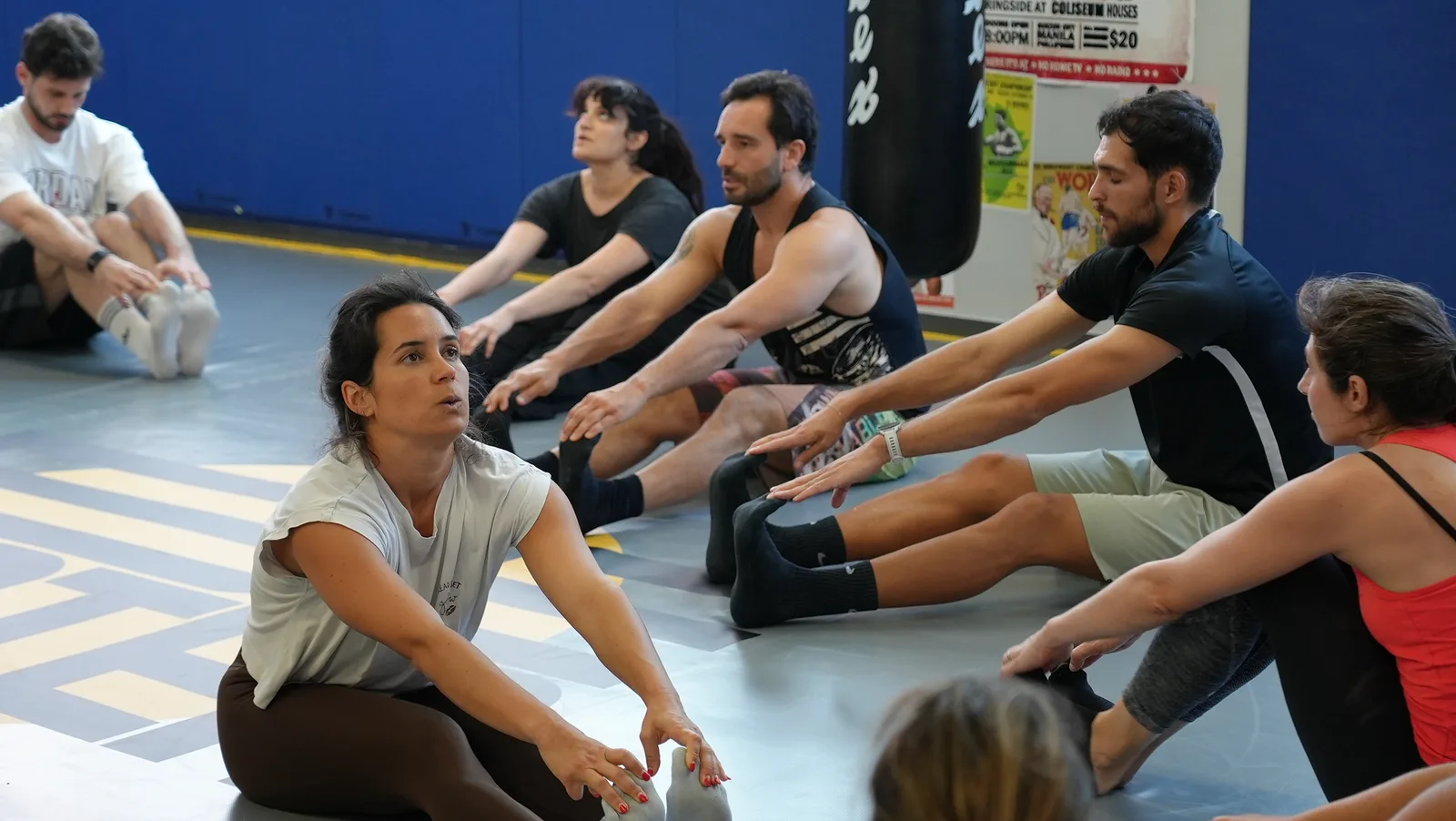
Classes are smaller, which means more individual attention from the coach than at any other point in the year. Nobody is looking at you, because there are few of us and everyone has been through a first day. And if you’ve always wanted to try that class you never got round to — Jiu-Jitsu, boxing, Muay Thai, BE FLEX — an August session with six people is the most comfortable door you’ll ever find.
The same goes for people already training: use it to try the class next door. Memberships give access to everything, and summer is when there’s room for it. If you’re undecided, read which class to choose.
September shouldn’t be a restart
The difference between arriving in September restarting and arriving in September continuing isn’t genetics, discipline or free time. It’s two or three unenthusiastic sessions a week across eight hot weeks.
You don’t need a perfect summer. You need a summer where you don’t disappear.
How to start
Your first class is free. Book it on WhatsApp (933 869 791) and pick the slot that works at this time of year — early morning, lunchtime, or end of day. Bring comfortable sportswear and a full water bottle.
Memberships start at €64.90/month, with no lock-in, and give access to every class: functional training, Jiu-Jitsu, boxing, Muay Thai and BE FLEX. See all the options on the pricing page.
Be Water Lisboa — Av. do Brasil 7, Campo Grande. Monday to Friday 07:00–21:00, Saturday 10:00–13:00, Sunday 11:00–12:30 (Open Gym + Open Mat).
— Be Water Team