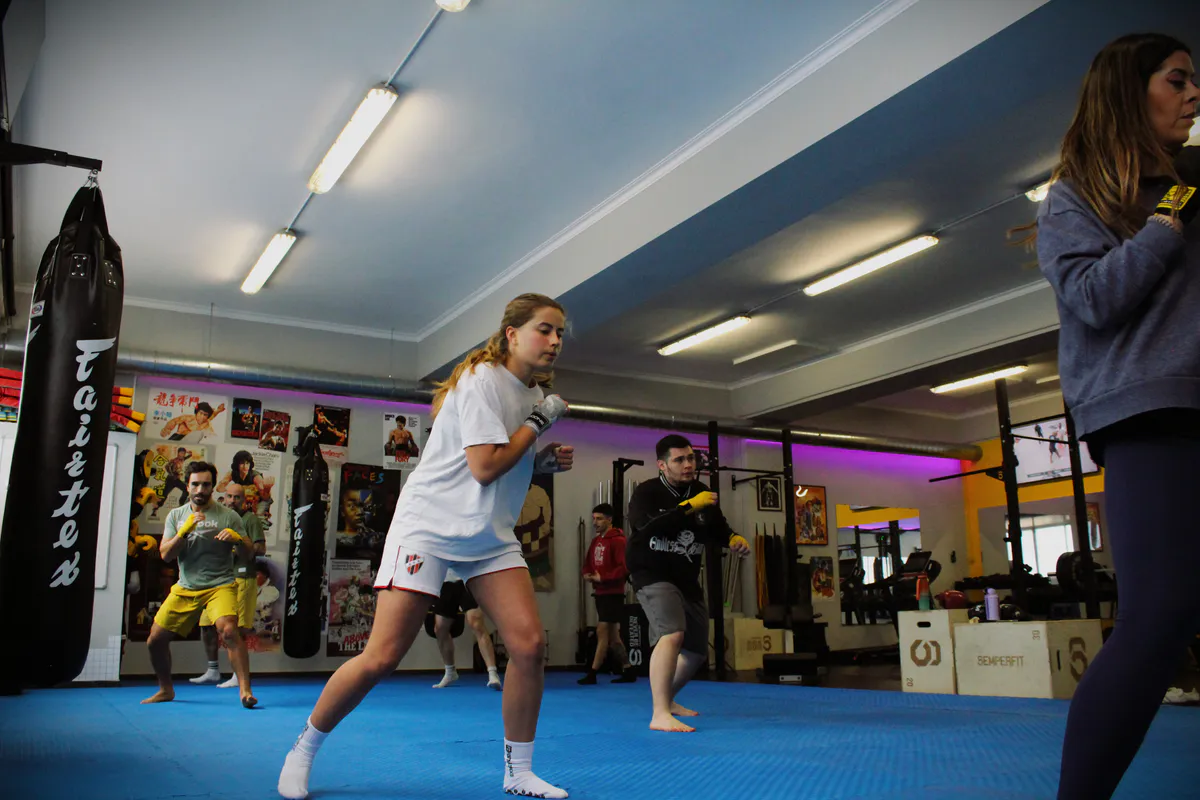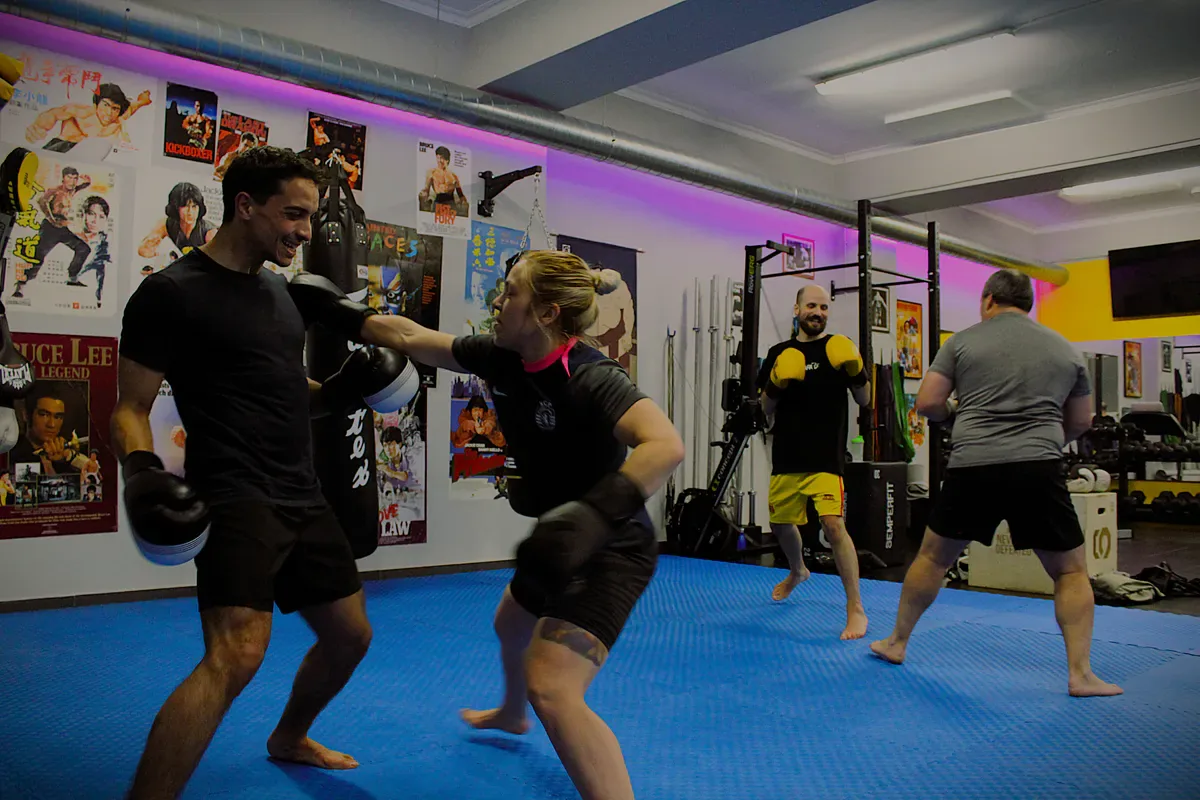
It’s probably the question we hear most from people who come in for a trial class knowing only that they want to hit something: boxing or Muay Thai?
The short answer is that neither is better. They’re different tools, suited to different people, and both solve the problem of learning to fight on your feet. The long answer — the one that matters, because you’ll be giving this three hours a week for years — is in this article.
The difference in one sentence
Boxing has two weapons. Muay Thai has eight.
Boxing works the hands exclusively, and that restriction is exactly what gives it depth: when you only have two instruments, every detail of footwork, head movement, angle and timing counts. It’s a sport of obsessive precision.
Muay Thai uses fists, elbows, knees and shins — hence “the art of eight limbs” — and adds the clinch, standing grappling with neck control and knee strikes. It’s a wider sport, with more ranges, more problems to solve and more pieces on the board.
Head to head
| Boxing | Muay Thai | |
|---|---|---|
| Weapons | Fists | Fists, elbows, knees, shins |
| Range | Short and mid, lots of movement | Long to short, including grappling |
| Standing grappling | No (the referee breaks it) | Yes, the clinch is central |
| Class rhythm | High and continuous, many rounds | More varied, technical and pad blocks |
| Entry curve | Gentler: few pieces, heavy repetition | Harder at first: more coordination |
| Mobility demand | Low | Medium to high (hips, for the kicks) |
| Legs | Work in stance and movement | Work as weapon and as defence |
| Starter gear | Gloves and wraps | Gloves, wraps, shin guards later |
What your first weeks of boxing look like
Stance, footwork, jab, cross, and the mechanics of driving force from the floor out through the hand. Plenty of bag and pad work with the coach, lots of head movement and close-range defence. Timed rounds with short rest — one of the toughest conditioning formats there is, and it shows within a few weeks.
Boxing classes are coordinated by Arménio Reis, six-time national champion. Learning to punch from someone who did it at the highest level is a difference you feel immediately in the detail of the corrections.
For the full guide, we have a complete article on boxing for beginners in Lisbon.
What your first weeks of Muay Thai look like
Thai stance, the teep (the front kick that manages distance), the round kick to the leg, knees, and your first notions of the clinch. A Muay Thai kick isn’t a leg movement — it’s a rotation of the whole hip, which is why it takes longer to settle than a jab. Early kicks are low and mid; high kicks are spectacle, leg kicks are what win fights.
Classes are with Diogo Calado, world and European champion, and there’s also a dedicated article on Muay Thai for beginners.
Which one comes together faster?
Boxing. Without much doubt.
There are fewer pieces to coordinate and the base technique repeats constantly, so after three or four classes you already have a stance that makes sense and a combination that flows reasonably. It’s a rewarding start.
Muay Thai asks for more patience in the early weeks: coordinating hip, base and arms in a round kick is genuinely harder than throwing a cross, and you’ll feel clumsy for longer. In exchange, the ceiling is higher — there’s far more to explore over the years.
One important note: this is not an argument for boxing. If the idea of kicking and kneeing excites you, a few frustrating weeks is a low price. The right sport is the one that makes you come back the following Tuesday.
What each one does to your body
Both deliver above-average cardiovascular conditioning, coordination no gym machine will build, and the stress release that only exists when you hit something hard. The real differences:
- Boxing: intense shoulder and arm work, core in constant rotation, and a cardiovascular system parked in high zones because of the round format. Excellent for reflexes and reaction speed.
- Muay Thai: recruits the legs as weapons, which brings far more hip, glute and core work. The clinch adds grip strength, posture and isometric endurance. It tends to be more demanding in overall energy cost because of the muscle chains involved.
Either way, mobility decides how long you can train without complaints — especially in Muay Thai, where a stiff hip limits your technique before it limits your strength. That’s why many people pair striking with BE FLEX.
And for self-defence?
Honest answer: both work, for different reasons.
Boxing gives you the most immediately useful skill in a real confrontation — fast hands, the ability not to get hit, and the instinct to keep moving. A large share of real situations start and end with the hands.
Muay Thai gives you more options, especially at range (the teep is a remarkable defensive tool for keeping someone away) and in the clinch, which is where many confrontations end up.
What neither solves on its own is fighting on the ground. If self-defence is your main motivation, it’s worth reading the article on which martial art to choose for self-defence before deciding.
Contact, sparring and the question nobody asks out loud
“Am I going to get beaten up in my first class?” No. In neither of them.
The first weeks are technique, bag and pads. There’s no contact to the face with beginners, in boxing or Muay Thai. Sparring comes later, controlled, and always by your choice — there are people who’ve trained for years without ever doing a serious round, and that’s completely fine.
The one difference worth flagging is that Muay Thai involves more body contact early on, because of the clinch. It isn’t aggressive, but it is close. For some people that’s the best part of the sport; for others it’s uncomfortable. Worth knowing which side you’re on.
Gear: what it actually costs
Practically the same for both, and less than you’d think. You need nothing for your first class — gloves are on us. After that, your own kit comes down to gloves, wraps and a mouthguard once you start making contact. Muay Thai adds shin guards, but only when you move into sparring, which isn’t for a while.
Clothing: in boxing, train in whatever you have. In Muay Thai, loose shorts or leggings, because you need range at the hip. No denim shorts, and no trainers on the dojo mat.
Choose by the timetable, not by the theory
This is the most practical advice in the article: the sport you’ll keep for years is the one that fits your week without negotiation. Here are the two side by side:
| Class | Days and times |
|---|---|
| Boxing | Monday and Wednesday at 18:20 · Tuesday and Thursday at 11:30 · Saturday at 12:00 |
| Muay Thai | Tuesday and Thursday at 19:15 · Friday at 18:30 |
Notice something: the times don’t clash. Boxing takes early evening on Monday and Wednesday plus mid-morning on Tuesday and Thursday; Muay Thai takes early evening on Tuesday, Thursday and Friday. That’s not an accident — it was designed so anyone who wants both can do both in the same week.
Check the full schedule with every class.
Why not both
Plenty of our members train boxing and Muay Thai, and Be Water memberships give access to every class at no extra cost — training both costs you no more than training one.
And the two together work better than either alone. Boxing fixes the classic weakness of a pure Muay Thai practitioner: underworked hands and a fragile close-range defence. Muay Thai fixes the classic weakness of a pure boxer: not knowing what to do when a kick shows up or when someone grabs hold of you.
A balanced week can be as simple as boxing on Monday, Muay Thai on Thursday, and a functional training session in between to hold both up.
Quick questions
Do I need to be fit to start? No. Same answer we give for everything else: the training is what gets you fit. Intensity is managed by the coach and you progress at your own pace.
Do I need to be flexible for Muay Thai? No. Flexibility develops with practice, and early kicks are low and mid.
Is Muay Thai the same as kickboxing? No. Kickboxing uses no elbows, no knees and no clinch. Different ranges, different weapons, different training culture.
Is it only for men? No. We have practitioners of all ages and genders in both classes. Technique offsets raw strength differences, and that’s precisely what makes striking accessible.
Can I start over 40? Yes, and we have plenty of people in exactly that situation. What changes is how you manage recovery, not whether it’s possible.
How to start
The best way to decide isn’t reading more articles — it’s going to both. The first class is free in any discipline, so try a boxing session on Monday and a Muay Thai session on Thursday and decide with your body instead of your head.
Book on WhatsApp (933 869 791). Arrive 15 minutes early, bring comfortable sportswear and a water bottle. Gloves and equipment are on us for your first session.
Memberships start at €64.90/month, with no lock-in, and give access to every class. See the Boxing and Muay Thai pages, or the full pricing.
Be Water Lisboa — Av. do Brasil 7, Campo Grande. Monday to Friday 07:00–21:00, Saturday 10:00–13:00, Sunday 11:00–12:30 (Open Gym + Open Mat).
— Be Water Team