There’s a question that always turns up around the one-month mark, once the novelty has worn off and someone starts taking this seriously: “how many times a week should I come, and what should I do on each day?”
It’s a better question than “which discipline should I choose”, because most people don’t want to choose a discipline. They want to get stronger, last longer, move better and have something technical to learn. That doesn’t come from one discipline, it comes from a well-built week. This article is about that: how to spread two, three or five sessions so they add up instead of running into each other.
First principle: the frequency you can sustain beats the ideal frequency
The best training week in the world is the one you’re still following in March. Four sessions kept up for a year change a body. Six sessions kept up for three weeks change your relationship with your alarm clock and nothing else.
So the first decision isn’t technical, it’s logistical: look at your actual week, with work, kids, dinners and traffic, and count how many fixed slots really exist. That number is your frequency. After that, yes, we decide what goes inside it.
Second principle: the disciplines don’t compete, they complete each other
People who train only one thing eventually hit a wall that belongs to the discipline, not to them:
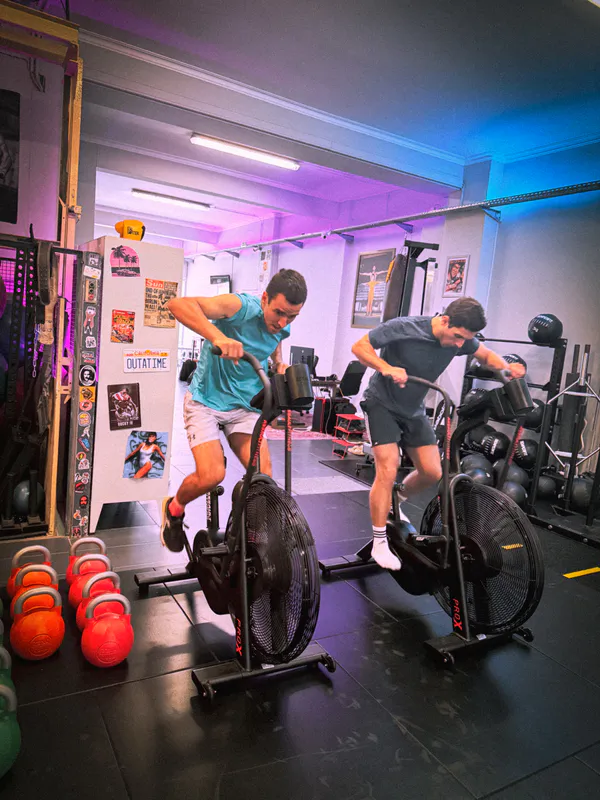
- Functional and strength training. This is the base. It gives you the ability to produce force, joint robustness and the cardiovascular engine everything else depends on. Without it, your Jiu-Jitsu is capped by strength and your Muay Thai is capped by gas.
- Jiu-Jitsu. Isometric strength, grip endurance, tolerance for discomfort and problem-solving under pressure. It’s the training that best teaches you to keep a cool head while your body is in the red.
- Boxing and Muay Thai. Power, coordination, rhythm and interval conditioning. It’s also the most effective way to unload a bad day, which in practice does more for your attendance than any physiological benefit.
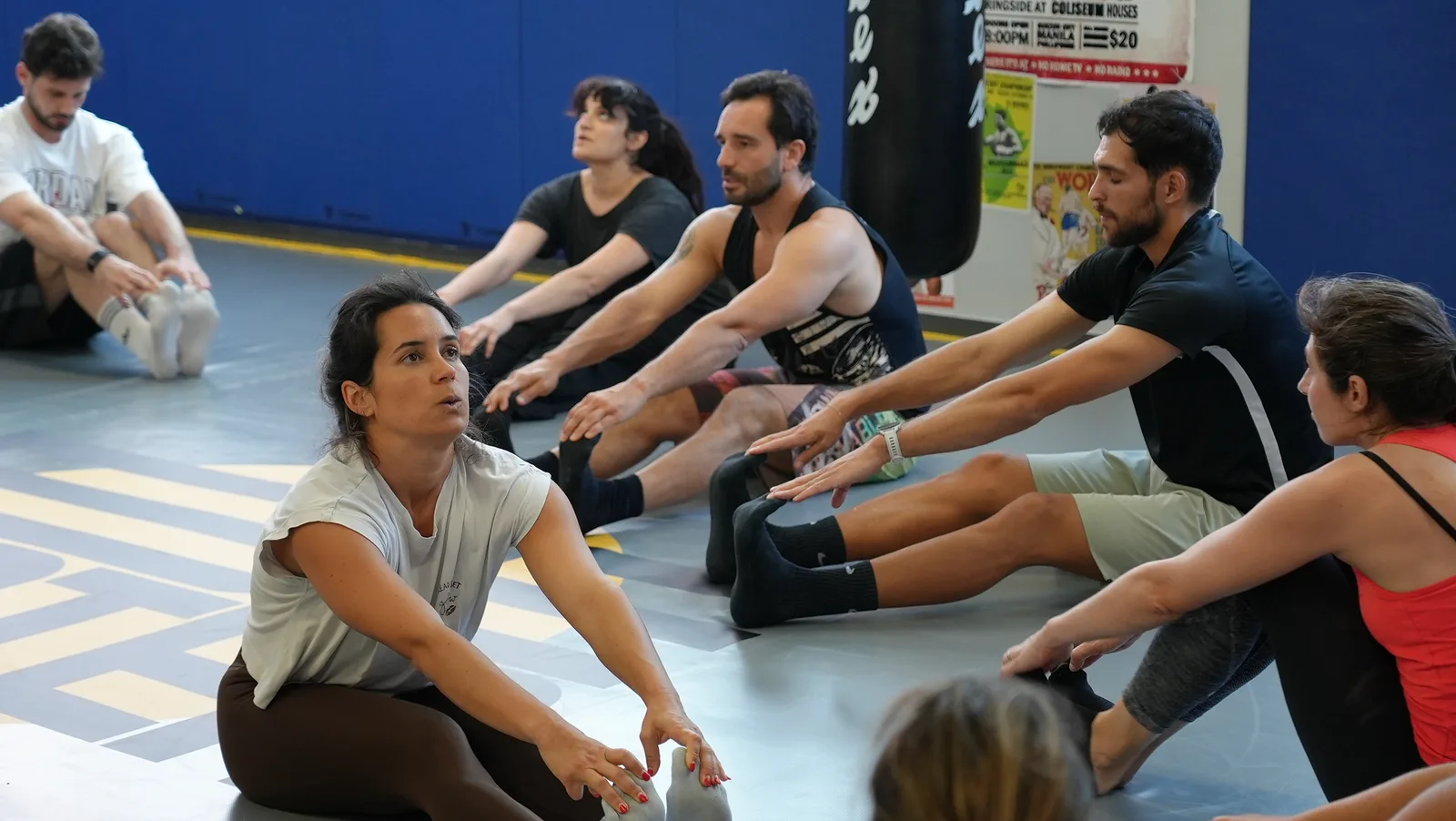
- BE FLEX and mobility. The range of motion that lets everything else be trained with technique instead of compensations. It’s the piece everyone cuts first and the one that’s missed the most.
The classic mistake isn’t training too little. It’s always training the same type of effort. Five high-intensity sessions a week aren’t an ambitious plan, they’re a plan with no easy days, and that bill always arrives.
The 2-sessions-a-week model
With two sessions, the temptation is to do your favourite discipline twice. It works for your head and poorly for your body, because two weekly exposures to a single stimulus give you very little base.
Our recommendation: one functional training session and one session of whatever brought you here.
- Tuesday: functional training at the end of the day
- Friday: Muay Thai or Jiu-Jitsu
If you’re a beginner in a martial art, one class a week is enough to learn, as long as you’re consistent. Two would be better, but one done for a year beats two done for a month.
A useful detail: the two-times-a-week membership counts accesses, not classes. You can stay for the next class on the same day without spending your other weekly session, which solves the problem for anyone who can only come twice but has time when they do. In practice, a Saturday morning can be functional training at 10:30 am and boxing at 12 pm.
The 3-sessions-a-week model
This is the frequency with the best ratio between results and real life, and it’s what we recommend to most people. Three variants, depending on the goal:
The hybrid (the most balanced). Two functional sessions and one martial art. You get measurably stronger and you have a technical discipline to learn over the years.
- Monday: functional training
- Wednesday: functional training
- Friday: Jiu-Jitsu or Muay Thai
The fighter. Two classes of your martial art plus one strength session that exists precisely so you can handle the other two.
- Tuesday: Muay Thai
- Thursday: Muay Thai
- Saturday: functional training
The one who wants to get strong and move better. Two strength sessions and one proper mobility session.
- Monday: functional training
- Wednesday: functional training
- Tuesday or Thursday: BE FLEX at 6:15 pm
Notice that in every model there’s at least one day between sessions of the same type. That isn’t accidental: adaptation happens during recovery, not during training.
The 4 to 5-sessions-a-week model
From here on, how you distribute sessions stops being optional and becomes the thing that keeps you intact. The rule is simple: don’t stack two hard days back to back, and put one clearly easy session in the week.
- Monday: functional training
- Tuesday: Muay Thai
- Wednesday: Jiu-Jitsu
- Thursday: BE FLEX (the easy day, and it isn’t negotiable)
- Saturday: functional training
- Sunday: Open Mat, if you feel like it
Anyone training at this volume benefits from one day a week spent purely on range of motion and breathing. It isn’t a rest day, it’s a maintenance day. We wrote about what mobility actually does for the rest of your training in the article on mobility and injury prevention.
Open Gym, open from 9:30 am to 12:30 pm and from 4 pm to 6 pm, works well as a low-intensity extra session: technique work, bag work, easy rowing, stretching. What it shouldn’t be is a fifth intense session piled on top of four.
Fitting your week into the real schedule
The Be Water schedule was built precisely to allow these combinations without forcing you to choose between disciplines. There’s functional training early in the morning, at lunchtime and at the end of the day, every weekday; Jiu-Jitsu in the morning, at lunchtime and in the evening, both GI and NO GI; boxing and Muay Thai at the end of the day and in morning slots; BE FLEX on Tuesdays and Thursdays at 6:15 pm; Open Mat on Sunday mornings. Check the full grid on the schedule page and build your week on top of what exists, not on what would be ideal.
Since every membership gives access to every discipline, the only difference between them is frequency: two accesses a week (€64.90/month), three (€79.90/month) or unlimited (€94.90/month). Your membership should follow the week you built, not the other way around. All the options are on the pricing page.
How to tell you’re training too much
It isn’t the number of sessions that defines excess, it’s how you respond to them. The signals worth watching:
- Your sleep gets worse instead of better
- Your motivation to train drops consistently for two weeks
- Performance stalls or drops at the same effort
- Joint pain shows up and doesn’t clear with a day off
- You’re constantly sore, even in movements you’re used to
The answer is almost never to stop. It’s to swap one intense session for a mobility session, sleep an extra hour, and start building back up two weeks later.
Reassess every eight weeks
A training week isn’t for life. It’s a hypothesis you test for two months and then judge with data: did you show up for the sessions you planned? Are you stronger in something measurable? Are you enjoying it? If the answer to any of those is no, change one element at a time, so you know what made the difference.
If you’re coming back after a break, start with the four-week plan in getting back to training in September and only then build your definitive week. If you’re at the stage before this one, still deciding where to start, the guide on which discipline to choose is the right starting point.
Next step
If you’d like, we’ll build your week with you. Book a free trial class on WhatsApp (933 869 791), tell us how many days a week you can genuinely train and what your goal is, and we’ll propose a concrete split on top of the schedule. No lock-in and every discipline included, so there’s nothing to lose in trying.
Be Water Lisboa - Av. do Brasil 7, Campo Grande. Monday to Friday 6:30 am to 9 pm, Saturday mornings, Sunday 11 am to 12 pm.
— Be Water Team