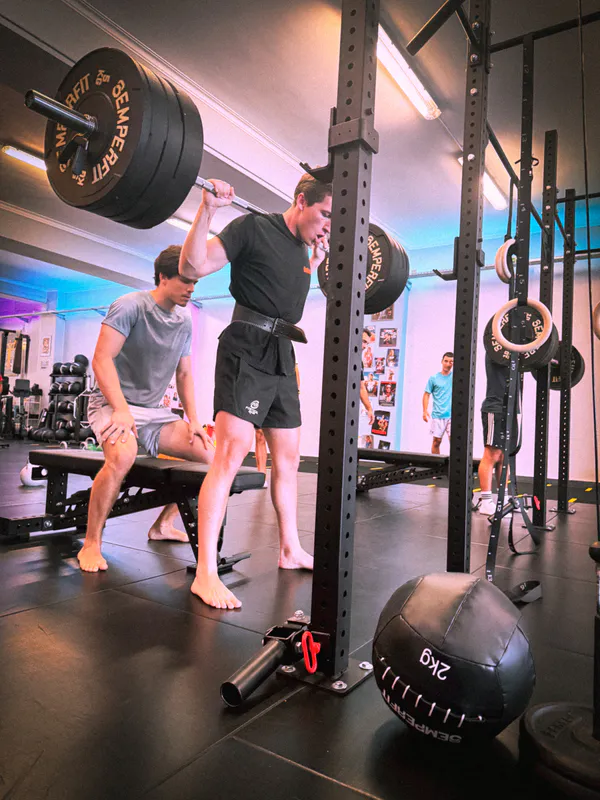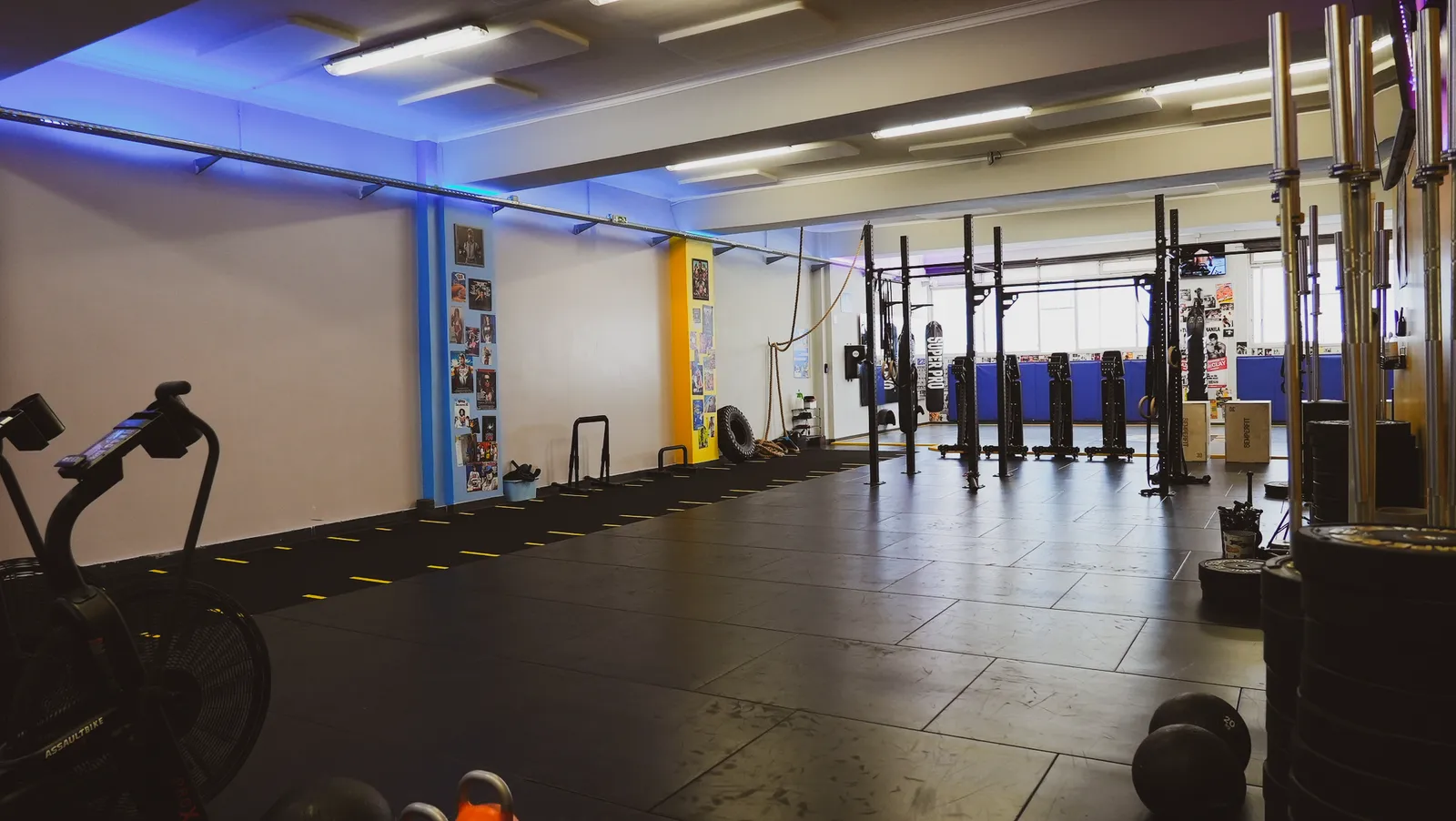
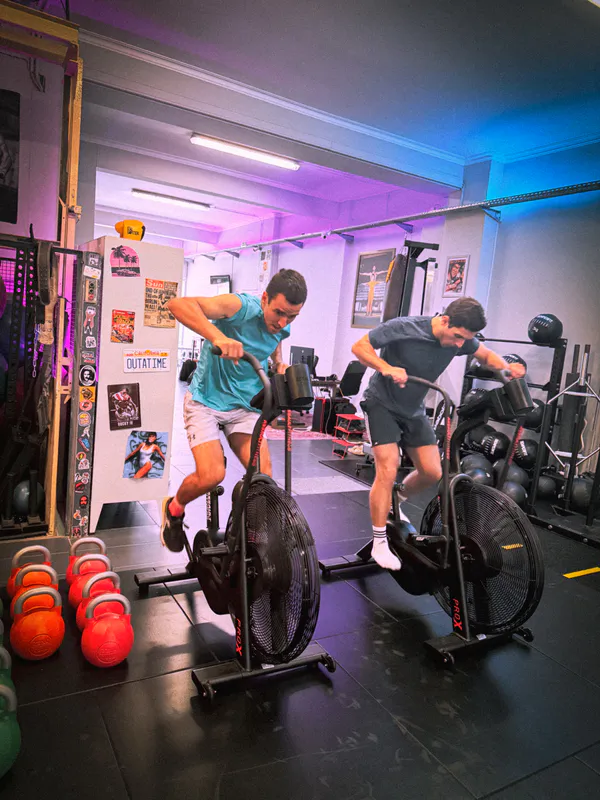
September is the best month of the year for a gym and the worst month of the year for people’s shoulders and knees. Everyone comes back at the same time, everyone comes back in a hurry, and almost everyone comes back trying to do the training they were doing in June. Two weeks later a good share of them have vanished: some because they got hurt, others because that first session wrecked them so thoroughly that their body now files the gym under punishment.
This article is the plan we hand to anyone who walks in at the start of September and says the usual line: “I did nothing all summer, I’m completely out of shape”. Four weeks, with what to do in each one. It isn’t motivation, it’s load management.
What you actually lost, and what you didn’t
The good news is that you lost less than it feels like. Cardiorespiratory capacity is the first thing to go and it’s the one that gives you that awful out-of-shape feeling: same effort, higher heart rate, less air. It’s also the one that comes back fastest, usually within two to three weeks of regular work.
Strength holds up far better than people think. After six weeks off, most people keep nearly all the strength they had. What you lost was mostly the coordination you produced it with, and that is relearned in days, not months. We covered this curve in detail in the article on training through the summer.
The real problem is a different one, and it’s the one nobody measures: tendons and ligaments adapt more slowly than muscle, and far more slowly than motivation. Two weeks in, your muscle can already handle June’s loads. Your patellar tendon and your rotator cuff cannot. That window, between week 2 and week 4, is exactly where September’s tendinitis shows up.
That’s why the plan below doesn’t raise the load at the speed you feel capable of. It raises it at the speed the rest of your body can follow.
Week 1: two or three sessions, and leave with fuel in the tank
The goal of the first week isn’t to burn calories or prove anything. It’s to relearn movement patterns and tell your body that this is normal again.
- Two or three sessions, with at least one day between them. If you were training regularly before the summer, start at three. If you’ve been off for several months, two is enough for this week. The brake here is the load, not the number of sessions.
- Practical load rule: at the end of every strength set you should feel you had another four or five reps in you. If you’re finishing sets at your limit, it’s too heavy for this week.
- Leave the session thinking you could have done more. That’s the sign week 1 went well.
- Don’t do sit-ups to failure or 100 burpees on day one. Nobody ever got back in shape in a single day, and plenty of people have ruined a month in one.
Expect muscle soreness 24 to 48 hours later, mostly in the legs. That’s normal and it passes. What isn’t normal is sharp joint pain, pain that shows up during the movement rather than the next day, or pain on one side only. If that happens, talk to the coach before your next session.
Week 2: add load, not volume
Keep the same number of sessions as week 1, or move from two to three if your body responded well. Either way, keep the same structure as the previous week and change one variable only: weight or intensity. If you squatted 20 kg in week 1, squat 25 or 30. What you shouldn’t do is add load and volume and a new discipline at the same time, because when something hurts you won’t know which one did it.
It’s also the right week to step back into a martial art, if that’s what you want. Jiu-Jitsu, boxing and Muay Thai carry a technical demand that naturally forces you to slow down, because you’re thinking about the movement instead of counting reps. That protects you.
Week 3: the week people quit
This is the week that matters. The novelty is gone, the September enthusiasm is gone, and visible results haven’t arrived. The scale hasn’t moved, the mirror looks the same, and training isn’t exciting any more.
What’s actually happening at this point is invisible: your nervous system is getting efficient, recruiting more fibres, coordinating better. You gain strength before you gain muscle, and you gain muscle long before you can see it. We break down the real timelines in the article on how long it takes to see results.
Three things that genuinely work in this week:
- Book your sessions in advance. A class booked in the app is a decision you’ve already made. A session “whenever it works out” is a decision you’ll have to make again at seven in the evening, tired, and you’ll lose.
- Train at the same time every day you train. Routine isn’t sustained by willpower, it’s sustained by repeating the context. Pick the slot and don’t negotiate with it for a month.
- Find someone who notices when you’re not there. It’s the reason group classes hold people far better than solo training plans. The exercise isn’t different, the other people are.
Week 4: this is no longer a comeback
By now you’ve stopped coming back to training and started training. This is when it makes sense to measure something concrete: the weight you lift for a set, your time in a circuit, the number of rounds you can hold without stopping. Without a starting reference, three months from now you won’t be able to prove to yourself that you improved, and that proof is what keeps you here.
It’s also now, and not before, that stepping up to four sessions a week makes sense. And if your life only allows two, two sessions done every single week are still a real plan: what doesn’t work is planning four and doing one. How to split those sessions between strength, fighting and mobility is a subject of its own, and we have a dedicated guide on how to build your training week.
The plan at a glance
| Week | Sessions | Focus | How you should feel afterwards |
|---|---|---|---|
| 1 | 2 to 3 | Relearn the movement, light load | Energy to spare |
| 2 | 2 to 3 | Add load, keep the structure | Tired, not wrecked |
| 3 | 2 to 3 | Hold the routine once enthusiasm fades | Bored, and showing up anyway |
| 4 | 3 to 4 | Measure and stabilise | Back in shape |
The four mistakes we see every September
Starting at five sessions a week. The five-day plan lasts, on average, nine days. Three sessions that happen for six months beat five sessions that happen for two weeks.
Coming back through the load instead of through the movement. Picking the weight you used before the holidays because it’s what your head considers fair is the fastest way to lose all of October.
Cutting mobility because it doesn’t look like real training. After a summer of sofa, beach and car, your limit will be range of motion, not strength. One BE FLEX session a week does more for your October than a fourth strength session.
Choosing the ideal time slot instead of the possible one. The 7:30 pm class is excellent if you can actually be there. If you leave work at 7:15 pm, your slot is 12:30 pm or 6:30 am, and it’s better to accept that now than in November.
Where this fits at Be Water
We run classes before work (6:30 am and 7:00 am, depending on the day), at lunchtime (12:30 pm), at the end of the day (from 6:15 pm) and on Saturday mornings. Open Gym runs from 9:30 am to 12:30 pm and from 4 pm to 6 pm for anyone who prefers training alone. On Sundays there’s Open Gym and a Jiu-Jitsu Open Mat from 11 am to 12 pm. Check the full schedule and pick the slot you can hold in November, not the one you fancy in September.
Every membership includes every discipline, at no extra cost and with no lock-in, which in September is useful for a concrete reason: you can use these first weeks to try functional training, Jiu-Jitsu, boxing, Muay Thai and BE FLEX, and only then decide where to settle. All the options are on the pricing page.
What if I stopped over a year ago, or never trained at all?
The plan is the same, with a week 0 in front of it: come in for a class, talk to the coach about old injuries and limitations, and let that first session be shorter than you’d like. People who have never trained actually hold an advantage over those coming back: they have no performance memory pulling at them. If that’s you, what your first class looks like answers the rest.
If you’re over 40, the progression logic shifts a little, mostly around recovery between sessions. It’s all in the article on strength training after 40.
Next step
Book your free trial class on WhatsApp (933 869 791). Arrive 15 minutes early, bring comfortable training clothes and a water bottle. And accept doing less than you think you can in that first week. It’s the only part of the plan that usually hurts.
Memberships start at €64.90/month, with no lock-in, and include every discipline: functional training, Jiu-Jitsu, boxing, Muay Thai and BE FLEX.
Be Water Lisboa - Av. do Brasil 7, Campo Grande. Monday to Friday 6:30 am to 9 pm, Saturday mornings, Sunday 11 am to 12 pm.
— Bruno Salgueiro, Founder